 WANLONG
Infrared bridge stone cutting machines are a common sight in the stone industry; however, many people remain unclear on the specific procedures involved in their cutting operations. The following outlines the standard workflow for cutting stone slabs:
1. Upon receiving a processing order, the machine operator must carefully review and thoroughly understand all its contents. Should any discrepancies or questions arise, they must be raised immediately; cutting operations may only commence once these issues have been resolved.
2. Inspect and verify that the type and quantity of the stone slabs positioned at the machine match the details specified in the processing order. Assess the slabs for any significant quality defects and maintain detailed records of your findings. If any discrepancies or issues are identified, report them promptly for appropriate resolution.
3. Prior to processing large slabs, verify their dimensions and specifications to ensure they are suitable for the intended cuts. If the actual dimensions deviate significantly from the requirements, immediately report this to the workshop technician for resolution; cutting may only proceed after receiving explicit approval.
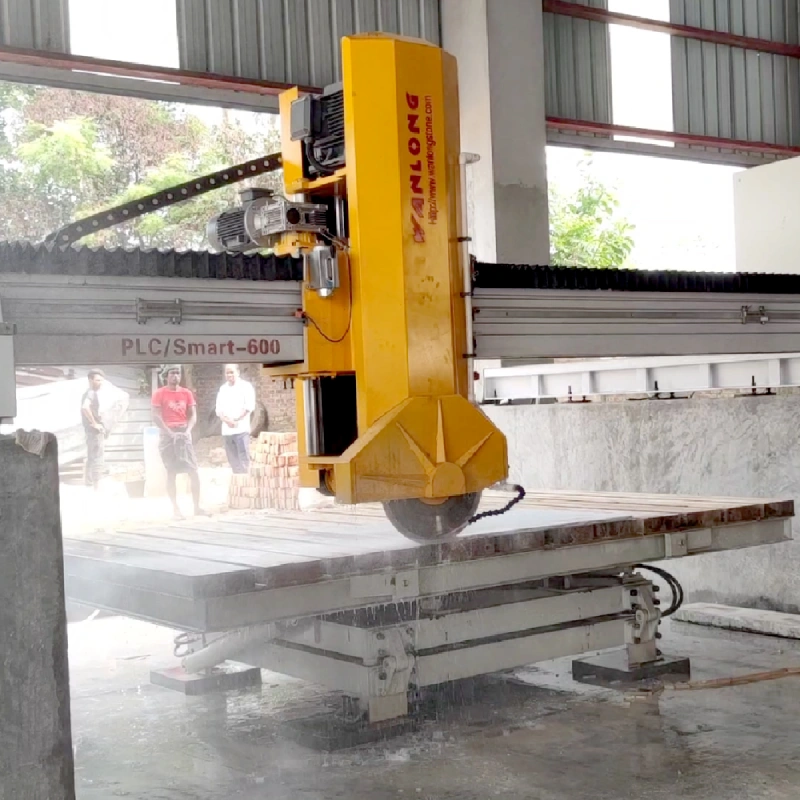
4. During processing, the layout of the slabs must be optimized to ensure that every individual slab—and every bundle of slabs—yields the highest possible material utilization rate.
5. In the event of defects such as color spots, color variations, or cracks, the operator should—provided it does not compromise the material yield—attempt to cut around these imperfections. If the client has specific requirements or if the processing order contains explicit instructions regarding such defects, they must be handled in strict accordance with those directives.
6. When processing brittle or fragile slabs, wooden padding must be placed beneath the support beams of the machine table when hoisting the slabs into position. Typically, such slabs should be hoisted individually; hoisting multiple slabs simultaneously is strictly prohibited. During processing, granite slabs are typically cut individually; however, when cutting marble using a ?400mm saw blade, it is permissible to process two slabs simultaneously.
7. Once the bridge cutting machine enters operational mode, the operator must maintain full concentration and remain vigilant. The saw blade should advance at an economical and efficient speed, the cutting stroke must be precise, and the distance of “idle cuts” (cutting through empty space) should be minimized as much as possible. As a general reference, an ideal cutting speed is approximately 20 units for granite and 30 units for marble. Specific operational parameters—such as cutting speed—must be adjusted based on the type of cutting tool, as well as the hardness and thickness of the stone slabs, to strictly prevent issues such as edge chipping, slab shifting, or incomplete/inaccurate cuts.