 WANLONG
Professionals in the stone industry are well aware that diamond wire saw cutting is a safer and more efficient method compared to traditional demolition techniques. Below is an introduction to the diamond wire saw cutting method.
Working Principle
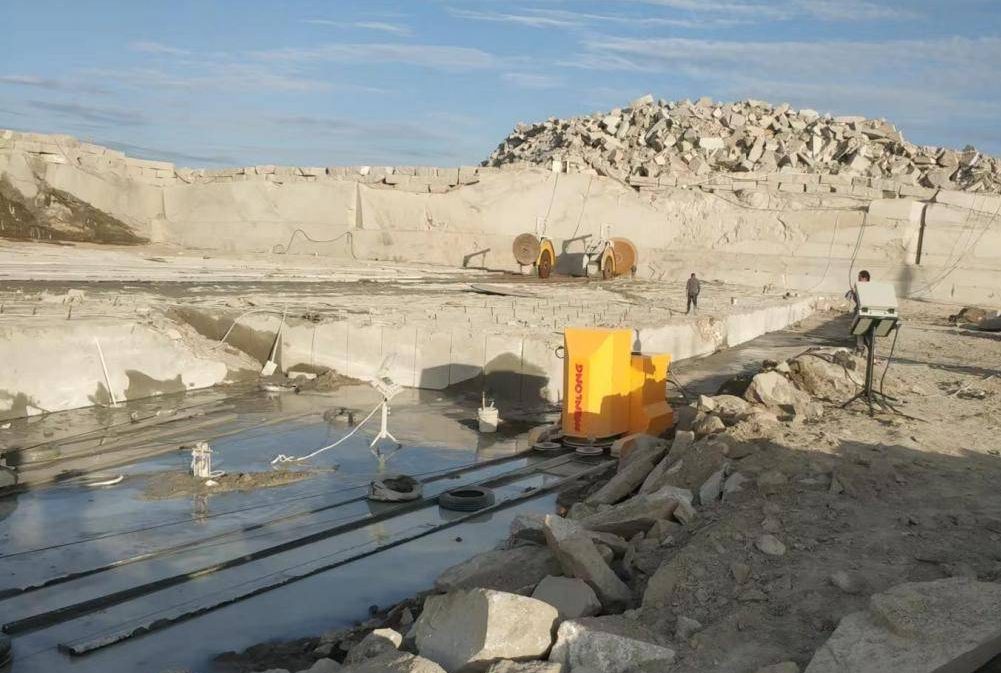
Hydraulic diamond wire saw cutting involves a diamond wire driven by a hydraulic motor; the wire moves at high speed across the cutting surface, grinding away the material to complete the cut. Because diamond particles serve as the abrasive material, the system can cut through hard materials such as stone and reinforced concrete.
Construction Characteristics
1. Using diamond as the abrasive material allows for the cutting and separation of virtually any hard object.
2. The cutting process is driven by a hydraulic motor; the hydraulic pump operates stably, and the motor can be controlled remotely via high-pressure oil lines. Consequently, vibration and noise during cutting are minimal, allowing the object to be separated statically and stably.
3. During operation, the high-speed diamond wire is cooled by water, which also flushes away grinding debris; the circulating water can be collected and reused.
4. The method is not limited by the shape or size of the object being cut and allows for cutting in any direction—diagonal, vertical, horizontal, etc.
5. Hydraulic diamond wire sawing offers high cutting speeds and power output unmatched by other cutting methods.
Scope of Application
1. Cutting and demolition of large reinforced concrete structures, such as the complete cutting and removal of buildings.
2. Cutting and demolition of various reinforced concrete bridges, abutments, piers, and foundations.
3. Cutting of underwater structures (a technically challenging application).
4. Precision cutting for the relocation of cultural relics and the detachment of cliff-face stone carvings.
5. Cutting of columnar structures, such as tall chimneys.
6. Cutting and demolition for structures with strict requirements regarding construction-induced vibration and noise, such as subway stations and nuclear power plants.
7. Quarrying and processing of stone materials.
Technical Standards
1. Wire redirection is achieved through a combination of guide wheels; during construction, the positioning of guide wheels relative to the drive wheel must be carefully designed to meet cutting requirements.
2. The linear cutting speed of the wire must be no less than 18 m/s. 3. The quality standards for the diamond wire must meet the requirements for maximum tensile strength during the cutting process.