 WANLONG
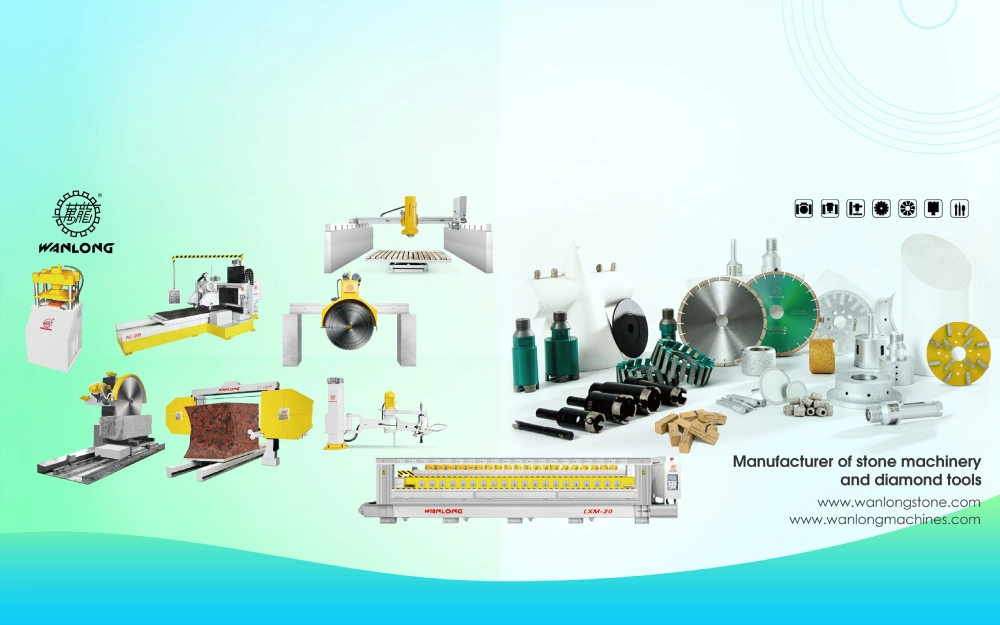
A complete granite thin slab production line typically consists of the following equipment: a bidirectional cutting machine, an automatic cutting machine, a leveling machine, a continuous polishing machine, and an edge grinding & chamfering machine.
The production process generally follows these steps: the bidirectional cutting machine cuts stone blocks into strips; the automatic cutting machine trims irregular edges at both ends of the strips; the leveling machine calibrates the slabs to ensure uniform thickness; the continuous polishing machine grinds and polishes the calibrated slabs to achieve the required surface gloss; the automatic cutting machine then cuts the polished slabs into specified project sizes; finally, the edge grinding & chamfering machine finishes the slab edges and corners.
1. Bidirectional Cutting Machine
The bidirectional cutting machine is the core equipment in marble and granite thin slab production lines. Using diamond circular saw blades as cutting tools, it cuts marble and granite blocks into slabs with specified thicknesses and dimensions.
The machine adopts a programmable fully automatic electrical control system. Functions such as block surface leveling, saw blade travel distance and speed, cutting depth for slab production, cutting depth of the vertical blade, travel speed of the horizontal blade, vertical blade lifting after each cutting cycle, block carriage movement, and repeated working cycles are all automatically controlled through preset programs. The machine offers stable performance, simple operation, and high cutting efficiency.
Working Principle
The vertical circular saw blade mounted on the spindle rotates continuously and performs reciprocating linear movement through a longitudinal traveling mechanism. During cutting, the diamond blade penetrates the stone, generating compressive and cutting forces that create saw kerfs. A lifting and feeding mechanism ensures accurate up-and-down movement and precise cutting depth of the vertical blade.
As the cutting path gradually moves downward, the stone block is cut into rough strips. A rotating horizontal saw blade then performs horizontal cutting to separate the strips, completing the full cutting process.
The machine can simultaneously install two types of saw blades:
Vertical saw blade: diameter ranging from 900–1600 mm
Horizontal saw blade: diameter of 400 mm
The width range of finished strips is typically 300–600 mm.
For marble thin slab production lines, a single-blade bidirectional cutting machine is generally used as the main machine. For granite thin slab production lines, a multi-blade bidirectional cutting machine is usually preferred for higher productivity.
2. Leveling Machine
The leveling machine is mainly used for thickness calibration of marble and granite thin slabs.
After cutting, the stone strips enter the leveling machine, where four grinding heads (single-head models are also available) continuously grind the slabs to ensure consistent thickness. The calibrated slabs are then transferred to the next polishing stage.
Once leveled, the slab surface becomes flatter and more uniform, significantly improving polishing speed and reducing polishing costs.
Working Principle
The motor drives the spindle through a V-belt system, causing the diamond grinding heads to rotate at high speed and grind the slab surface.
The cut strips are continuously transported onto the conveyor belt through roller tracks. Under the guidance of pressing and guiding systems, the slabs move steadily while passing through four diamond grinding heads in sequence, gradually achieving uniform thickness.
Production capacity: 150㎡–200㎡/8h.
3. Continuous Polishing Machine
The continuous polishing machine is designed for grinding and polishing marble and granite thin slabs after cutting and leveling. It produces a smooth, glossy surface that meets finishing requirements.
This equipment can automatically complete the entire grinding and polishing process in a continuous operation. It delivers high production efficiency and consistent polishing quality, making it one of the key machines for large-scale decorative stone processing.
Working Principle
Leveled strips are continuously fed onto the conveyor system via roller tracks. With the support of pressing and guiding devices, the slabs move steadily while special polishing abrasives mounted on high-speed rotating polishing heads apply continuous grinding and polishing pressure.
As a result, the upper surface of the slab becomes smooth and polished, achieving the required gloss level.
Production capacity: 180㎡-280㎡/8h.
4. Automatic Cutting Machine
The automatic cutting machine is used to trim irregular ends of strips cut by the bidirectional cutting machine and to cut polished slabs into finished engineering slab sizes.
Working Principle
The motor drives the spindle and circular saw blade through a belt transmission system. Stone slabs placed on the worktable move along guide rails, allowing the rotating saw blade to cut through the material and complete the trimming or sizing process.
5. Edge Grinding & Chamfering Machine
The edge grinding & chamfering machine is the final processing equipment used to finish standard slabs after cutting. It performs edge grinding and chamfering to improve appearance and installation quality.
Working Principle
Slabs transported from the automatic cutting machine move along the conveyor belt and first pass through grinding wheels with preset grinding parameters.
As the slab continues moving, it triggers a control rod that activates a travel valve. Compressed air enters the cylinder and pushes the chamfering grinding head against the slab edge to begin chamfering.
The chamfer size is controlled by cylinder pressure through a regulating valve, with pressure settings determined through testing. After single-side grinding and double-edge chamfering, the slabs are transferred to the next process via belt conveyor.
Production capacity: 1,000–1,200 standard slabs per 8-hour shift.