 WANLONG
Design Principles and Machining Process for Crossbeam Guide Rails in Stone Machinery
As stone processing moves toward higher precision and deeper fabrication, the mechanical performance of stone cutting equipment has become more important than ever. For factories that process marble, granite, quartz, and engineered stone, stable machine movement is directly tied to cutting accuracy, surface quality, and long-term production efficiency.
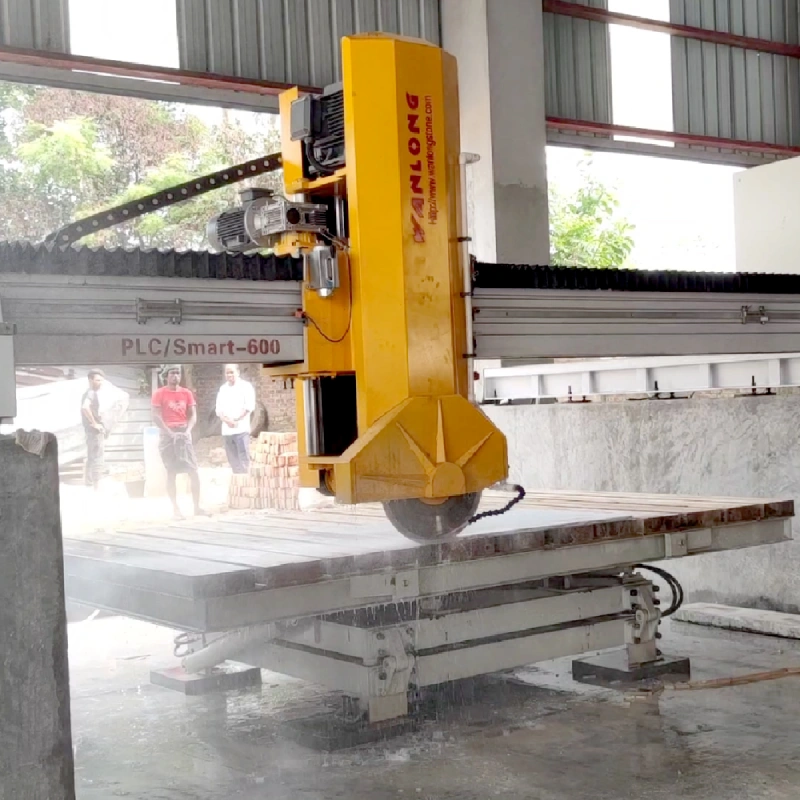
Among different types of stone machinery, the bridge stone cutting machine remains one of the most commonly used machines in stone workshops. It is known for accurate cutting, low failure rates, easy operation, and wide material compatibility.
One of the key parts that affects the performance of this equipment is the crossbeam guide rail. Its structure, machining quality, and wear resistance all influence how smoothly and accurately the machine runs over time.
Common Crossbeam Guide Rail Structures
There are two common guide rail combinations used in stone machinery crossbeams: the triangular guide rail with rectangular guide rail combination, and the double triangular guide rail combination. Both are open guide rail structures.
The guiding performance of a triangular guide rail is related to its top angle. A smaller angle gives better guiding performance, but it also increases the equivalent friction coefficient of the guide rail surface. In normal stone machinery design, the top angle of a triangular guide rail is often set at 90 degrees.
For heavy-duty or large stone machinery, the load is much higher, so the angle can be increased to about 110 to 120 degrees. When the triangular guide rail surface wears over time, the worktable naturally sinks slightly, which helps compensate for part of the wear.
Rectangular guide rails have good rigidity and are easier to machine, inspect, and repair. Their drawback is weaker guiding performance compared with triangular guide rails.
Double triangular guide rails offer better guiding accuracy and better accuracy retention. However, because this structure is over-positioned, machining, inspection, and maintenance are more difficult.
Why Guide Rail Wear Is a Major Concern
Stone machinery usually works in a harsh environment. During cutting, stone dust, water mist, and diamond particles can splash onto the guide rail surface. Since stone sawing is a heavy-load cutting process, the guide rail surface is more likely to wear quickly.
Some stone machines still use double triangular guide rails on the crossbeam because this structure can help compensate for wear. When designing and machining this type of guide rail, several requirements should be carefully controlled.
1. Guiding Accuracy
The guide rail must maintain enough guiding accuracy during both idle movement and cutting movement. This accuracy directly affects the working quality of the machine.
Several factors influence guiding accuracy:
- Structural form of the guide rail
- Geometric accuracy of the guide rail
- Contact accuracy of the guide rail surface
- Rigidity of the guide rail and base components
- Thickness and stiffness of the oil film
- Thermal deformation of the guide rail and supporting parts
Geometric Accuracy
For straight-motion guide rails, geometric accuracy usually includes three main items:
- Straightness in the vertical plane
- Straightness in the horizontal plane
- Parallelism between the two guide rail surfaces, also known as twist accuracy
For vertical and horizontal straightness, both the straightness per meter and the straightness over the full guide rail length should be checked. For twist accuracy, the twist value between the two rail surfaces should also be measured per meter and across the full length.
The tolerance values for these items can be selected according to relevant machine tool accuracy inspection standards.
Contact Accuracy
For guide rail surfaces finished by precision planing, grinding, or scraping, contact accuracy can be checked by the coloring method according to JB2278-78. The result is measured either by the contact area percentage or by the number of contact points within a 25 mm × 25 mm area.
2. Accuracy Retention
Accuracy retention mainly depends on the wear resistance of the guide rail. It is also related to friction behavior, guide rail material, processing method, load condition, and machine structure.
Residual stress in the guide rail and base parts may also cause slight deformation over time, which can reduce long-term accuracy. Among all these factors, wear is the most direct reason for accuracy loss.
Improving wear resistance is therefore a major part of improving stone machinery quality. It should be considered from several sides, including design, machining process, material selection, heat treatment, lubrication, and daily use.
From a design point of view, the basic idea is simple: reduce wear as much as possible. If wear cannot be avoided, it should be kept low, distributed evenly, and designed in a way that allows compensation after long-term use. This helps extend the working life of the equipment and keeps cutting accuracy stable for longer.